Why Choose a Case Erector for Your Packaging Needs?
In the competitive world of packaging, efficiency is crucial. A Case Erector stands out as a vital tool for any business. It automates the process of forming boxes, saving time and labor costs. Imagine a factory floor bustling with activity. Workers struggle to keep up with demand as they manually erect cartons. Such scenarios can lead to delays and errors.
Investing in a Case Erector simplifies this process. It ensures consistent and precise box formation, reducing the risk of damaged packages. The machine operates swiftly, allowing for a seamless workflow. However, some businesses hesitate. They may worry about initial costs or maintenance. It's important to weigh these factors against long-term benefits.
Staying competitive means embracing change. If your packaging needs are growing, a Case Erector might be the next logical step. Reflect on current processes and ask if there’s room for improvement. Automation is not just a trend; it's becoming a necessity. Consider the possibilities that come with upgrading your packaging operations.
Benefits of Using a Case Erector in Packaging Operations
Using a case erector can transform your packaging operations significantly.
It speeds up the packaging process. Manual labor is often slow and error-prone.
A case erector automates this task, which saves time and reduces mistakes.
As a result, you can meet higher production demands effortlessly.
Tip: Always assess your packaging volume.
If you are experiencing bottlenecks, a case erector might be the solution.
Look for flexibility in case sizes. This ensures that the machine fits your varied packaging needs.
Additionally, a case erector improves workplace safety.
Fewer manual operations mean a lower risk of injuries.
Workers can focus on more critical tasks.
However, training might be necessary. Not all employees are familiar with such machines.
Make sure to invest time in proper training sessions.
Tip: Monitor your case erector regularly.
Maintenance is key to long-lasting performance.
Consider having a dedicated team for this purpose.
Consistent checks can prevent unexpected downtimes.
Understanding the Functionality of a Case Erector
A case erector is a crucial machine in packaging. It automatically forms flat cardboard into boxes. This process saves time and reduces labor costs. Operators can quickly adjust the settings for different box sizes. This flexibility is valuable for businesses that handle various products.
Understanding how a case erector works reveals its benefits. These machines use a combination of suction and pressure to fold boxes. Once erected, the boxes can be filled immediately. The automated system minimizes errors. However, maintenance can be a challenge. Components may wear out, requiring regular checks. Neglecting this can lead to production delays.
Not all products fit neatly into standard boxes. Sometimes, specific shapes or sizes are needed. A case erector may not always accommodate these unique needs. Businesses must balance efficiency with product specifics. Finding the right case erector involves careful consideration. The best choice can enhance productivity while meeting various packaging demands.
Comparing Case Erectors to Manual Packaging Methods
When considering packaging methods, case erectors stand out. They automate the process of forming boxes, reducing manual labor. Unlike manual methods, which can be slow and prone to errors, case erectors ensure consistency. Each box is formed the same way every time. This uniformity can enhance the overall appearance of products.
Manual packaging can force workers into repetitive motions. This leads to fatigue and potential injuries. Workers may struggle with securing boxes properly. In contrast, a case erector streamlines this task. It eliminates the risk of misaligned boxes. The machine handles the folding and sealing with precision. This frees up workers to focus on other tasks that require human touch.
However, investing in a case erector isn't without challenges. Initial costs can be high. Maintenance is essential, and technicians may be needed regularly. A learning curve exists for the staff. They must understand how to operate and troubleshoot the machine. The benefits, though, often outweigh these concerns. Over time, the efficiency gained can result in significant cost savings.
Benefits of Case Erectors vs. Manual Packaging Methods
Cost Efficiency: Investing in a Case Erector
Investing in a case erector can significantly enhance your packaging efficiency. These machines automate the process of assembling cardboard boxes. As a result, they reduce labor costs and save time. Labor is often one of the biggest expenses in packaging. By minimizing manual assembly, companies can reallocate those resources elsewhere.
However, the initial investment might seem high. This can cause hesitation among decision-makers. It's essential to consider long-term savings. Case erectors boost productivity by speeding up the packaging process. An efficient operation leads to lower operating costs over time. This means more focus on quality and less on repetitive tasks.
Moreover, working with a case erector may require some adjustments. Employees need training to operate the new machinery effectively. This transition can be challenging but worthwhile. Adapting to automation can lead to smoother workflows in the long run. Reflecting on both the immediate financial impact and the potential for growth is crucial. This investment can pave the way to more efficient, cost-effective packaging solutions.
Why Choose a Case Erector for Your Packaging Needs? - Cost Efficiency: Investing in a Case Erector
| Feature |
Traditional Method |
Case Erector |
Cost Impact (%) |
| Labor Cost |
High |
Low |
-30% |
| Speed of Operation |
Slow |
Fast |
+40% |
| Waste Reduction |
High |
Low |
-20% |
| Flexibility with Sizes |
Limited |
High |
+25% |
| Initial Investment |
Low |
High |
+50% |
Choosing the Right Case Erector for Your Business Needs
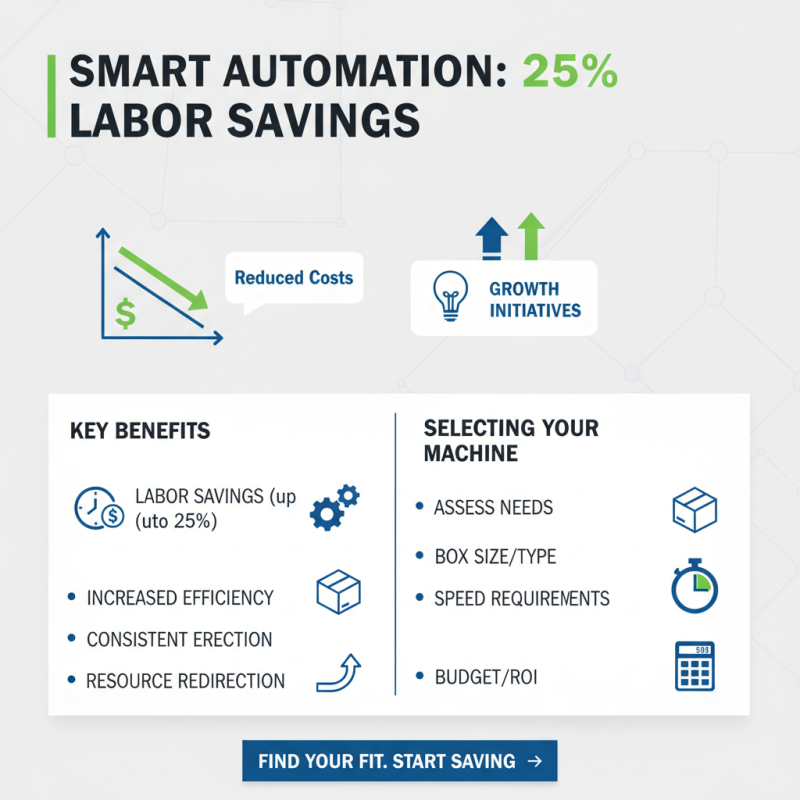
Selecting the right case erector is crucial for your packaging process. Industry reports indicate that automation can reduce packaging labor costs by up to 25%. This significant saving allows businesses to redirect resources to growth initiatives. However, not all case erecting machines suit every operation. Understanding your specific requirements is the first step.
Consider your production volume. If your output exceeds 50 cases per minute, a high-speed case erector may be essential. However, for lower volumes, a simpler machine might suffice. Also, pay attention to the types of cases you use. Different designs may require unique adjustments. Adapting your infrastructure to accommodate these machines can incur extra costs.
Furthermore, the ease of maintenance is a vital factor. Reports suggest that machines with user-friendly designs lead to reduced downtime. A complex machine may seem attractive, but it could create challenges in training your staff. Evaluate your workforce's skills. Are they ready for sophisticated equipment? Reflecting on these aspects can improve your production efficiency.
 English
 Español de México