 English
 Español de México


How to Choose Fluted Coupe Glasses for Your Business?
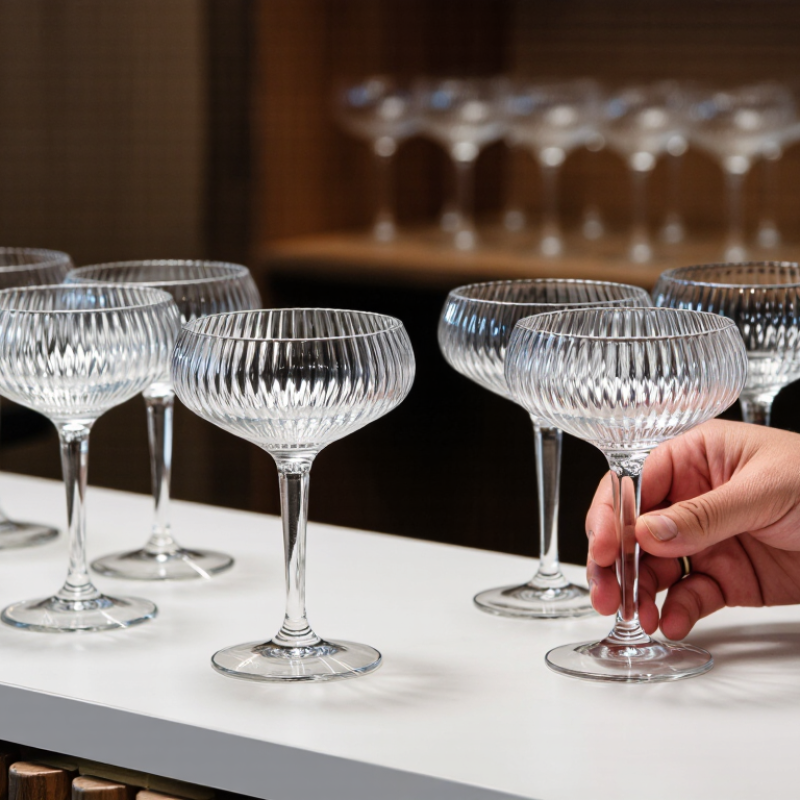
For bars, hotels, restaurants, and event venues, glassware shapes both service and presentation. Fluted Coupe Glasses bring a vintage silhouette, a textured bowl, and a broad rim to cocktails, sparkling wine, and celebratory pours. Their appearance matters, but daily handling matters more. A glass that photographs beautifully may feel awkward during a busy Friday service.
Choosing the right style starts with the way your team serves drinks. Check capacity, rim width, stem length, weight, and how securely the glasses fit on your shelves. Ask whether the bowl suits your standard recipes and whether staff can carry several glasses comfortably. Small details count. Deep fluting may catch attractive highlights, yet it can also make fingerprints or cleaning marks more visible under bright lights. Verify care guidance and supplier specifications rather than relying on product photos alone. If possible, order samples and test them during real service. That step is easy to skip, but useful.
This guide explores practical ways to compare materials, dimensions, durability, and cost before placing a business order. It also considers brand style, replacement availability, and the needs of different service settings. No glass works perfectly for every venue. Your best choice depends on your menu, storage, washing routines, and budget—and those priorities may change over time. Be willing to reassess. A considered purchase can improve the guest experience while helping your team work comfortably and consistently.
Define Your Business Needs and Intended Serving Uses
Define the job before choosing the glass. Will fluted coupes carry sparkling wine, signature cocktails, desserts, or several menu items? A coupe used for a chilled aperitif needs different capacity and handling than one holding a foamy, garnished cocktail. Measure the pour, garnish height, and space between glasses on your tray. Then check the glass’s rim, bowl depth, stem length, and stability. A narrow stem may look elegant, but it can slow service when staff carry several drinks at once.
Plan around real service conditions, not just the shelf display. The National Restaurant Association’s 2024 State of the Restaurant Industry report projected U.S. restaurant sales of $1.1 trillion. That figure describes a vast, varied industry; it is not a glassware demand forecast. Your own covers, peak-hour pace, breakage records, dishwasher capacity, and storage space are better buying evidence. I would avoid assuming one coupe suits every use. That assumption can leave a bar with attractive glasses that are awkward to wash or too small for its pours.
Tips: Test one sample through a full service cycle. Pour your standard drink, add its garnish, carry it on a loaded tray, and run it through your usual wash process. Ask staff where it feels awkward. Their feedback may be imperfect, but it can reveal problems a catalogue photo cannot.
How to Choose Fluted Coupe Glasses for Your Business? — Define Your Business Needs and Intended Serving Uses
| Business Need | Intended Serving Use | Suggested Capacity | Design Features to Consider | Practical Buying Guidance |
|---|---|---|---|---|
| Cocktail bar with a varied menu | Classic cocktails served without ice, such as a Sidecar or Daiquiri | 5–7 oz (150–210 ml) | A broad bowl provides room for the drink and garnish; a stable stem and balanced foot support handling and presentation. | Choose a versatile capacity that leaves space at the rim. Order a sample set and test the glasses with your standard recipes and garnishes. |
| Champagne or sparkling-wine service | Sparkling wine served in individual portions | 6–8 oz (180–240 ml) | A coupe has a wide, shallow bowl, so it does not retain carbonation as long as a flute. A smooth, chip-resistant rim is useful for frequent service. | Select coupes for the intended style and visual presentation, rather than for prolonged bubble retention. Confirm the actual usable pour volume before ordering. |
| Restaurant with limited storage | Table-side cocktails, aperitifs, and small dessert portions | 5–7 oz (150–210 ml) | Check bowl width, overall height, and whether the foot sits securely on your shelves and service trays. | Measure storage racks and dishwashing equipment first. Compare the packed dimensions and stacking guidance for the specific glass design. |
| High-volume venue | Repeated service during busy shifts and frequent washing | 5–7 oz (150–210 ml) | Prioritize a sturdy stem-to-bowl connection, a stable base, and glassware specified as suitable for the venue’s washing process. | Ask suppliers for care instructions and replacement availability. Test a small quantity through your normal handling and washing routine before a larger order. |
| Hotel or event service | Welcome drinks, receptions, and coordinated table settings | 6–8 oz (180–240 ml) | Consistent appearance across the set and a base that feels stable on trays and tables help with presentation and service. | Confirm the delivery schedule, case quantity, and spare-glass allowance against your event size and storage capacity. |
| Dessert-focused service | Mousse, sorbet, fruit, or other small plated desserts | 5–8 oz (150–240 ml) | A wide opening makes layered desserts and toppings easier to see and access. Check that the bowl shape suits the portion and serving spoon. | Test a representative dessert portion in the glass. Consider bowl depth and opening width, not capacity alone. |
Note: Capacity ranges are practical selection guides, not fixed standards. A glass’s total capacity is greater than its recommended serving pour; confirm dimensions and usable volume with the supplier before purchasing.