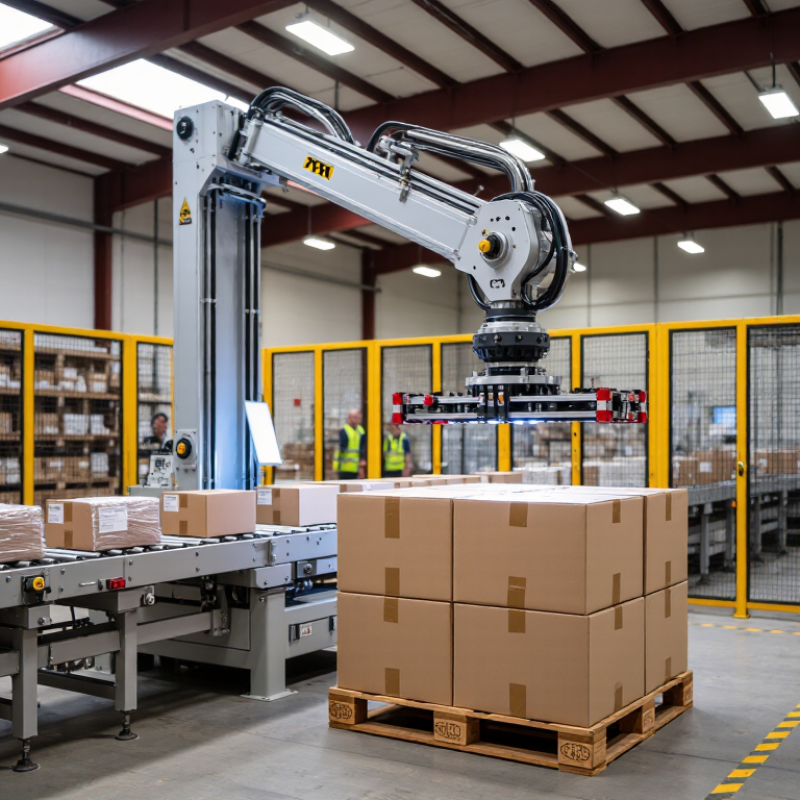
| Primary operating principle |
Rotates and places products using four controlled axes. |
Uses six axes to approach products and pallets from multiple angles. |
Collaborative robotic arm places products with integrated safety functions. |
Forms complete layers before transferring them onto the pallet. |
| Typical payload range |
80–300 kg, depending on model and tooling. |
10–250 kg, depending on reach, speed, and end-of-arm tooling. |
5–30 kg, including the gripper payload. |
Typically 50–300 kg per layer-handling cycle. |
| Typical throughput |
Approximately 600–1,200 bags or cases per hour. |
Approximately 300–1,000 cases or bags per hour. |
Approximately 200–600 cases per hour. |
Approximately 1,000–2,000 cases per hour in high-volume applications. |
| Best-suited load types |
Bags, cartons, trays, boxes, and uniform containers. |
Mixed cartons, irregular packages, containers, and products requiring angled access. |
Light cartons, small boxes, bags, and frequent product changeovers. |
Large volumes of uniform cartons, cases, or bags. |
| Pattern flexibility |
High; patterns are changed through robot programming. |
Very high; supports complex orientations and multi-face handling. |
High for low- and medium-speed operations. |
Moderate; optimized for defined products and pallet patterns. |
| Typical footprint |
Medium; commonly requires a guarded robotic cell. |
Medium to large, depending on robot reach and pallet locations. |
Small to medium; can often be installed in constrained spaces. |
Large, due to layer-forming conveyors and transfer mechanisms. |
| Changeover capability |
Fast software-based changeover for multiple SKUs. |
Very fast for mixed-SKU operations when vision and recipe controls are available. |
Fast and suitable for short production runs. |
Slower when product dimensions or pallet patterns change. |
| Safety arrangement |
Normally uses fencing, interlocked gates, scanners, and emergency stops. |
Normally uses fencing, interlocked gates, scanners, and emergency stops. |
May operate without full guarding only after a documented risk assessment and compliant safety configuration. |
Usually requires guarding and interlocked access points. |
| How the work cycle operates |
Conveyor detects the load; gripper picks it; robot moves to the programmed position; load is released and the cycle repeats. |
Sensors or vision identify the load; six-axis motion optimizes approach, orientation, placement, and pallet access. |
Operator loads a recipe; cobot receives product data; gripper picks and places each item while monitored safety functions control interaction. |
Products are accumulated into a layer, aligned, transferred as a group, and stacked on the pallet. |
| Main strengths |
High speed, repeatability, and strong suitability for standard pallet patterns. |
Maximum reach and flexibility for difficult product orientations. |
Compact installation, simpler redeployment, and useful human-machine collaboration options. |
Very high throughput for stable, standardized production. |
| Typical buyer profile |
Manufacturers needing reliable automated palletizing at medium to high volume. |
Facilities handling diverse products, complex layouts, or variable pallet patterns. |
Small and medium manufacturers prioritizing flexibility and limited floor space. |
High-volume plants with stable products and continuously repeated pallet patterns. |
 English
 Español de México